The surprising similarity between TMS and ketamine

webThumb TMS ket similar

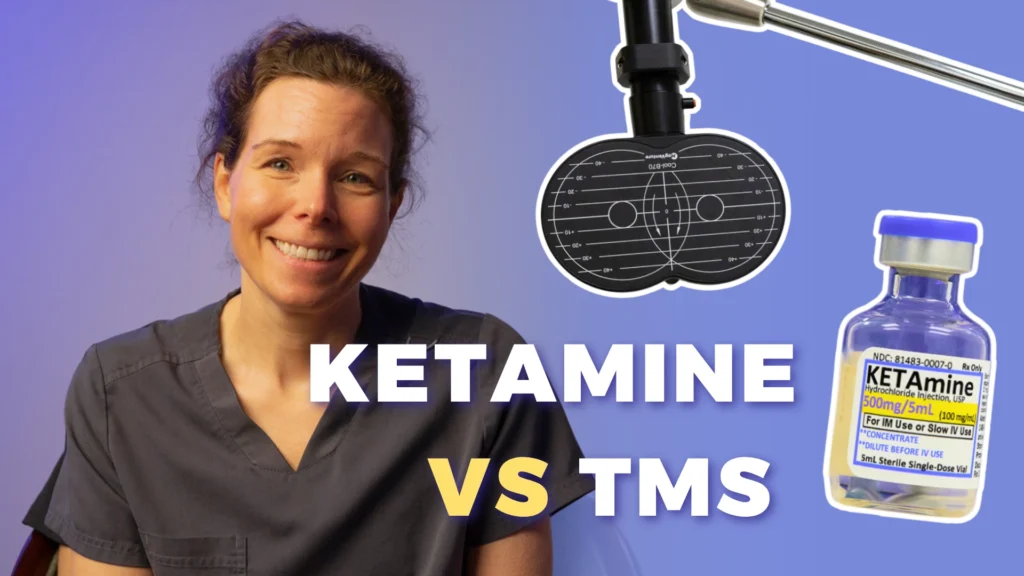
TMS and ketamine are both highly-effective interventional treatments for mental health symptoms and conditions, including depression, anxiety, OCD, and other mood disorders and some pain conditions. They look wildly different at a quick glance, and they rely on totally different technologies. And yet, they have surprising similarities — not just in what they can help…

TMS

TMS uses electromagnetic waves to stimulate targeted areas of the brain. The procedure involves a 3D positioning system, controlled power unit, and liquid cooled coils that deliver a series of pulses to the brain or other specific areas of the body. Multiple treatments are provided over days or weeks, followed by maintenance treatments. Reduction of symptoms, even for treatment-resistant symptoms, is impressive for many people.

Ketamine

Ketamine – in particular, IV ketamine treatment – uses a controlled dose of ketamine delivered intravenously to the bloodstream. The procedure includes placing an IV and delivering a calibrated dose with a controlled pump. Patients complete an initial series followed by maintenance treatments for effective and lasting results. Reduction of symptoms, even for treatment-resistant symptoms, is impressive for many people.

Distinct Procedures

On the face of it, these procedures look starkly different. One relies on electromagnetic waves delivered by a calibrated machine to targeted areas (usually in the brain). The other relies on a chemical medication delivered to the entire body via the bloodstream.

Key differences between TMS and Ketamine might be summarized as:

  • Machine vs Medication
  • Non-Invasive vs Infusion
  • Targeted vs Systemic
  • Electrical vs Chemical

Underlying Similarities

Despite the apparent differences, TMS and ketamine are surprisingly similar in the way that they work. Both procedures effectively stimulate healthy activity of neurons in a fundamentally similar way.

Neurons are electrochemical. They rely on both electrical and chemical signaling and pathways for their activity. As such, they are impacted by external electromagnetic stimulation – such as direct electrical current in the case of procedures like ECT, or electromagnetic waves from intense sources like pulsing TMS coils. They are also affected by chemical interaction or stimulation, including from psychedelic medications such as ketamine.

Both TMS and Ketamine treatments:

  • Act on neurons.
  • Modulate glutamatergic transmission. Glutamate pathway effects are thought to be central to how both of these procedures work to improve neural activity and improve mood regulation 
  • Induce Synaptic Plasticity, also called Neuroplasticity. This is part of the promotion of healthy neuron activity and, importantly, may permit changes in the default mode network, helping to resolve unhealthy ruminating thought and activity patterns
  • Reduce inflammatory markers affecting neurons. Growing research suggests that inflammation is related to poor neuron activity and that both procedures may be beneficial in part due to their anti-inflammatory effects.
  • Provide rapid-acting and lasting reduction of depression symptoms and symptoms of other conditions for many people – especially with infusion treatments for ketamine and when using accelerated TMS protocols.

Should I pursue ketamine, TMS, or both?

Both procedures can be excellent options for treating depression, anxiety, OCD, PTSD, and other mood disorder and pain conditions – including treatment resistant symptoms. At least one study showed equally-effective results between versions of the two procedures for treatment-resistant depression, for instance. In many cases, either would be appropriate and the decision of which to pursue can be guided by factors such as personal preference, recommendations by your physicians or other providers, considerations of cost, and schedule constraints.

TMS is generally better for patients looking for targeted and non-invasive treatments. It may be better suited for more mild cases of depression and anxiety. It may possibly provide more durable results than ketamine, without the need for quite as many maintenance treatments.

Ketamine is likely better for treating generalized and non-specific mood disorders and pain conditions, as the systemic nature of the medication affects all the neurons in the body. Ketamine is generally used for more rapid symptom reduction when response time is important. Ketamine may also be better for harder-to-treat symptoms and conditions, and is often used when TMS has failed to deliver significant improvements.

Growing research shows that there is promise in pursuing both treatments together! Because of the differences in the treatments, using both of them increases the chances that you’ll effectively achieve substantial and lasting symptom reduction. Furthermore, some researchers hypothesize that ketamine may increase the receptiveness of neurons to TMS (or vice versa), resulting in a super-additive effect where the treatments do more than complement each other – they boost each other – resulting in a situation where, by illustration, one plus one equals three. 

These are only general guidelines, and the specifics make a difference. The patient, the presentation of their symptoms, and the details of the treatment employed all make a difference. Importantly, the effectiveness of each treatment can vary significantly depending on the protocol used, the equipment used, and other details of treatment. Intranasal ketamine is generally less effective than IV ketamine infusions, for instance. Similarly, conventional rTMS is generally less effective than accelerated TMS. 

Exceptional Treatment Options

These treatments look very different at first glance. They rely on different technologies, they look quite different, and they feel very different. Despite their differences, their mechanisms of action in stimulating healthy neuron activity appear to be very similar. The significant overlap in the things they treat and the results they yield is likely due to these similarities in the way they work. They are both exceptional treatment options, yielding significant positive results for many people.

About Us

Wells Medicine is a Houston-based practice designed to provide meaningful care for mental health. Providing targeted interventional treatments for Depression, Anxiety, OCD, PTSD and other conditions, with Ketamine Treatments, Stellate Ganglion Blocks, TMS, and Nitrous-Oxide Treatments. Focused on comprehensive care and integration with Psychiatry, Psychology, and Support Services. We are evidence-based, patient-focused and mission-driven.

The content here is for informational purposes and should not be relied upon for medical decisions. For the details of your specific medical conditions and treatments consult your doctors or other qualified healthcare professionals.