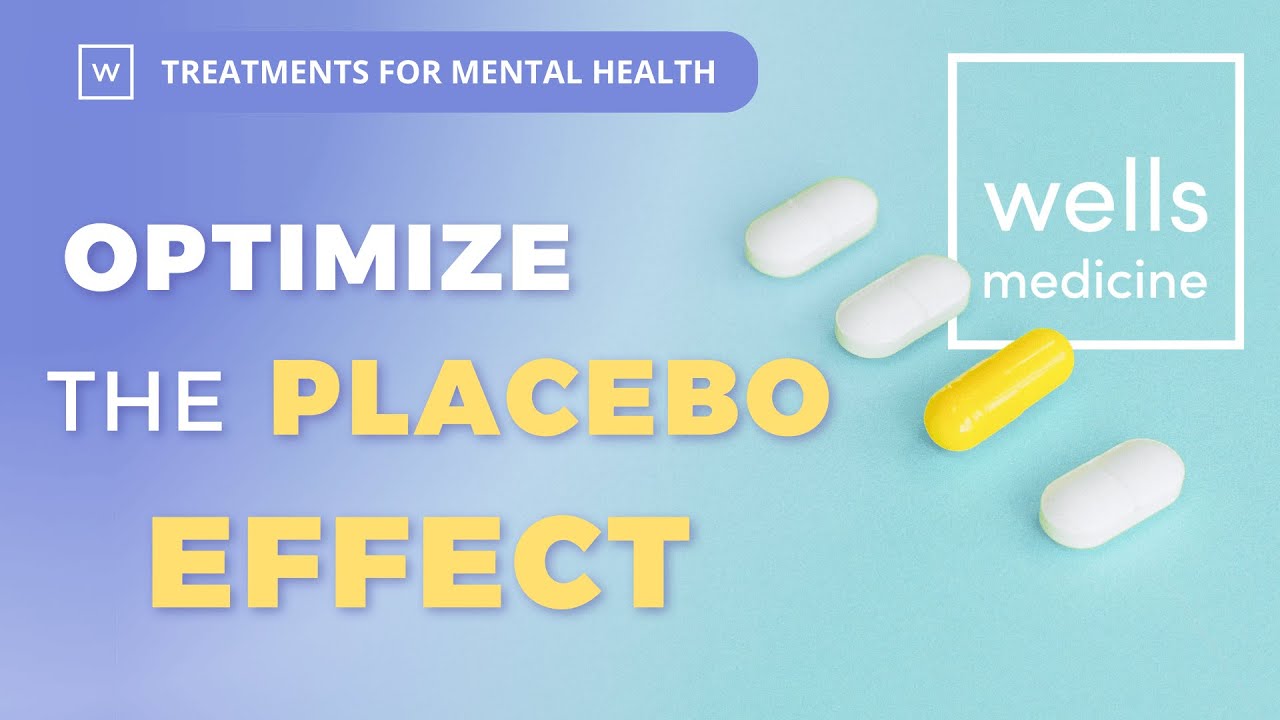
The way you think about treatment may influence the benefit that you see from it. The placebo effect is real, and can be strong, and affects all kinds of interventions. Positive expectations may help maximize your results.
The placebo effect
In clinical trials, patients are typically split into two groups. One will receive the active intervention that is being studied. The other group serves as the control and receives a non-functional, sham treatment, called the placebo. The placebo treatment is classically a ‘sugar pill’ — a pill made of sugar, without any active drug ingredients.
In medicine, we see that even if you are in the placebo group and aren’t receiving an active intervention, you may still receive 20-30% of the results of the active intervention. By simply believing you are receiving a treatment, you can see some results. This phenomenon is called the placebo effect.
The placebo effect is real, and yields real results. The effect can be seen for all manner of conditions and treatments. It can dramatically change our response to potent pain medications. It can yield physical changes in our bodies. It can yield changes to our mental health.
The placebo effect may even appear when participants simply look at, or become consciously aware of, the study criteria. For example, in a study on exercise and health, participants were shown to experience real improvements to their physical health (decrease in weight, blood pressure, body fat, waist-to-hip ratio, and body mass index) simply by being informed of the study details, without any recorded change to behavior. In another study on diet and health, participants had different physiological responses after being provided with different information about the very same food.
The placebo effect can heighten results of an active intervention, it can produce positive results from a sham intervention, and it can produce positive results from information only … and it can also yield side effects. Patients may take a sugar pill and say, “I have a worsening headache,” for instance, or “my sex drive went down” — things you wouldn’t expect to see from a non-intervention.
The placebo effect is fascinating and is ever-present in medicine.
The nocebo effect
There is a phenomenon somewhat opposite to the placebo effect, called the nocebo effect. This refers to giving someone an active intervention where you tell them it won’t work anyway, or that it could actually be doing harm.
For example, using the headache study, you may give someone a standard migraine medication and tell them “Well, but this is just the placebo. This is just a sugar pill. It won’t work anyway.”
What you find with the nocebo effect is that there is a decrease in the effectiveness of treatment — simply by making the patient doubt or believe that it will not work.
How you think matters
The way you think about treatment can influence the kind of benefit you see — as shown by the placebo and nocebo effect.
All of the treatments provided by Wells Medicine are evidence-based, real treatments supported by research. Regardless of demonstrated efficacy, we ask patients to prepare for and anticipate good outcomes.
It is important that the patients themselves believe in the treatment, and that their family members believe in the efficacy of the treatment as well. Many of our patients have been given a label of ‘treatment-resistant, and have tried numerous medications or treatments before. They may be frustrated and say, “Nothing has ever worked. This won’t work either.”
It is important to come into treatment with at least neutral hope for the efficacy of treatment, rather than carrying all of our past experiences, failures, and disappointments. The expectation of whether something is going to work or not can be quite strong and can help improve already effective treatments.
The goal isn’t to trick yourself into making the treatment have an effect, but to be open to taking advantage of all of the effect available to us to receive the greatest possible benefit from treatment.
Select References
Laferton JAC, Kube T, Salzmann S, Auer CJ, Shedden-Mora MC. Patients’ Expectations Regarding Medical Treatment: A Critical Review of Concepts and Their Assessment. Frontiers in Psychology. 2017;8:233. doi:10.3389/fpsyg.2017.00233.
Constantino MJ, Vîslă A, Coyne AE, Boswell JF. A Meta-Analysis of the Association Between Patients’ Early Treatment Outcome Expectation and Their Posttreatment Outcomes. Psychotherapy. 2018;55(4):473–485. doi:10.1037/pst0000169.
Bingel U, Wanigasekera V, Wiech K, Ni Mhuircheartaigh R, Lee MC, Ploner M, Tracey I. The effect of treatment expectation on drug efficacy: imaging the analgesic benefit of the opioid remifentanil. Science Translational Medicine. 2011;3(70):70ra14. doi:10.1126/scitranslmed.3001244.
Colloca L, Miller FG. The nocebo effect and its relevance for clinical practice. Psychosomatic Medicine. 2011;73(7):598–603. doi:10.1097/PSY.0b013e3182294a50.
About Us
Wells Medicine is a Houston-based practice designed to provide meaningful care for mental health. Providing targeted interventional treatments for Depression, Anxiety, OCD, PTSD and other conditions, with Ketamine Treatments, Stellate Ganglion Blocks, TMS, and Nitrous-Oxide Treatments. Focused on comprehensive care and integration with Psychiatry, Psychology, and Support Services. We are evidence-based, patient-focused and mission-driven.
The content here is for informational purposes and should not be relied upon for medical decisions. For the details of your specific medical conditions and treatments consult your doctors or other qualified healthcare professionals.