
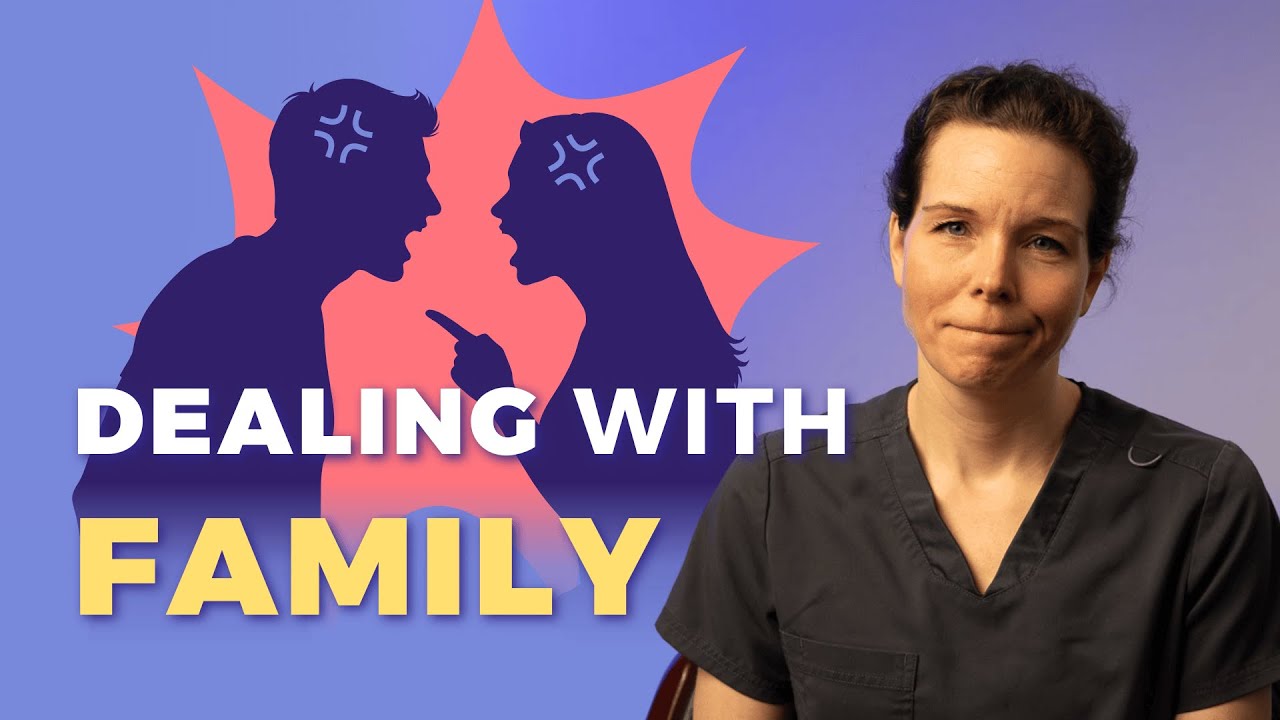
Returning to families of origin during the holidays can trigger traumas and re-ground your nervous system into a past, traumatic state. You have a few options in how you choose to move forward with difficult relationships.
Returning to trauma
During the holidays, people often return to spend time with their families of origin. Returning to the family dynamics you grew up with, and being expected to fall into your usual role, can trigger traumas and re-ground the nervous system into a past, traumatic state. This experience can feel regressive, and prevent you from staying settled into the growth you may have created for yourself.
This can be happen when you return to a toxic relationship — whether between parent and child, with siblings, extended relatives, or friends you meet back in your hometown — or even by returning to a location where trauma has occurred, whether it’s your old bedroom or the church you grew up in.
Tensions can be high as you enforce boundaries that you have worked to create with the people around you. The people you have created these boundaries for may not respect or honor them, and may react badly to the new balance of power and shift in dynamics. They may not have had the therapy, or practice, or time to adjust to the new version of your relationship.
Where treatment fits in
Interventional treatments including ketamine can help address your heightened nervous system and assist you to break out of and recover from trauma loops. Ketamine can help you to become ‘unstuck’, and to reestablish the healthier patterns you have created for yourself.
Navigating relationships
When patients have done a lot of work on themselves to unpack their traumatic past and feel that they have made great personal progress, we often see them express that they want to go home and clear the air with their family. They want their family members to see things from their perspective and to acknowledge the hurt that they were caused, or to acknowledge the environment they were in, or the needs they had that went unmet.
This does not always result in success. If you’ve talked to a family member again and again and they are still not acknowledging your hurt or your trauma, it does not mean that your trauma is not real. Your trauma can be very real, and due to a variety of reasons — a lack of psychological sophistication, lack of emotional resources, or denial in order to protect themselves or other people — your family members may not be able to meet you where you are or to acknowledge your side of the story.
You may have deep and real traumas that the people in your life may never validate, and may never see their contribution to. When this happens, we suggest that there are only a few possible options for what you can do next.
Option 1
The first option is to continue to push for your family member to change their behavior and to see things from your perspective.
This can often feel like pushing against a brick wall, and can be a recipe for disappointment and frustration if your family member has continuously failed to change.
Option 2
Your second and third option begin by evaluating your relationship with the other person to determine — is it worth it?
Are you getting enough of what you need emotionally out of your relationship to justify glossing over your hurts? Are you able to let the issue go and move on from it for your own well-being?
This may look like shifting your relationship to a version that works for you — maybe only talking about the weather, or about sports, or about the food on the table. Whatever your new relationship looks like, you should be able to get enough out of it emotionally to justify setting aside and moving past your hurts.
Option 3
If you’ve evaluated your relationship and determined that it is not worth it — it is time to move on from that relationship. Seek out other relationships that may be more supportive or more beneficial for the person you are now.
Option 4
If your family member has continuously failed to change their behavior or their perspective, there may never be a fourth option where they meet you where you are and move forward with your relationship in harmony. There may never be a time where they understand perfectly where you’re coming from, or never say a hurtful thing, or join with you against the person who is hurting you.
You may only have those three options — continuing to push, accepting your relationship as it is and taking emotionally what you can from it, or moving on from the relationship.
It is important to remember that your trauma is still real and to figure out how to move forward with your relationships in a way that is healthy for you.
About Us
Wells Medicine is a Houston-based practice designed to provide meaningful care for mental health. Providing targeted interventional treatments for Depression, Anxiety, OCD, PTSD and other conditions, with Ketamine Treatments, Stellate Ganglion Blocks, TMS, and Nitrous-Oxide Treatments. Focused on comprehensive care and integration with Psychiatry, Psychology, and Support Services. We are evidence-based, patient-focused and mission-driven.
The content here is for informational purposes and should not be relied upon for medical decisions. For the details of your specific medical conditions and treatments consult your doctors or other qualified healthcare professionals.


