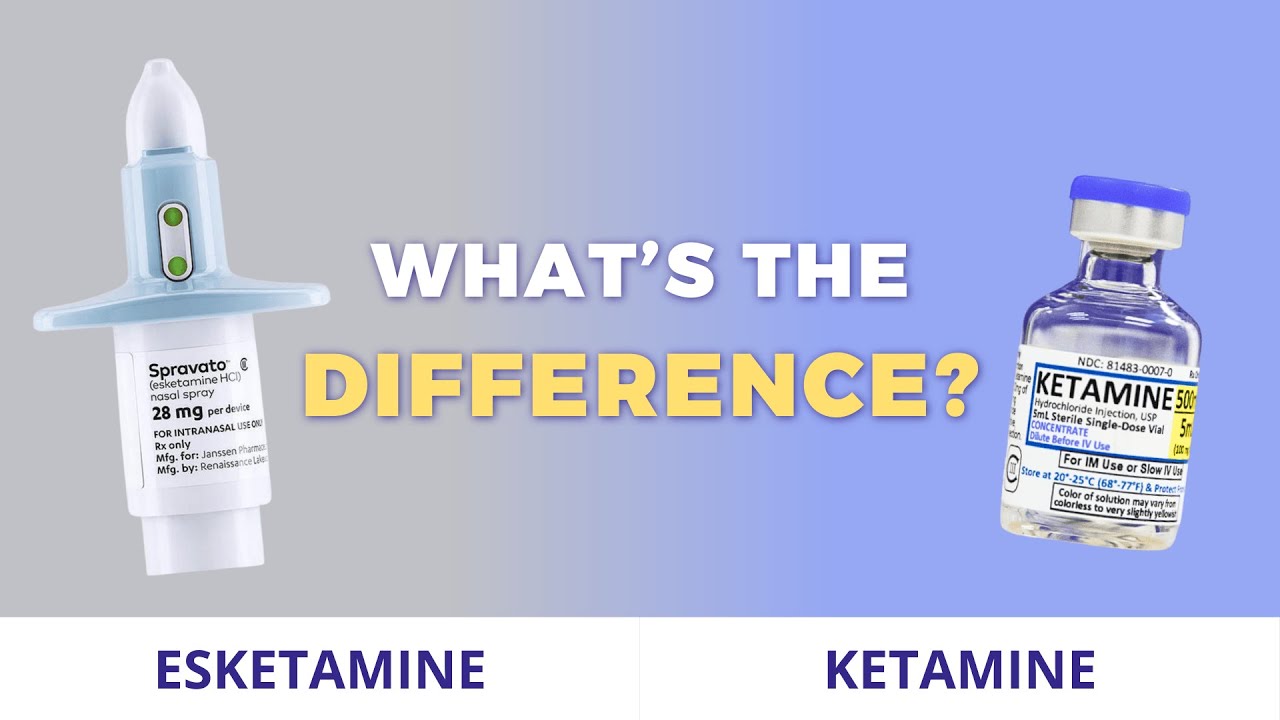
Esketamine, the active ingredient in Spravato, makes up half of racemic ketamine, which is used in most other ketamine treatments. While both medications are used to treat mental health, they have different levels of effectiveness.
Racemic ketamine, commonly known just as ketamine or generic ketamine (because it isn’t controlled by patent), is a synthetic medication that was developed in the early 1960s. It is ‘racemic,’ meaning that it is made up of an equal parts of mirror-image forms of the same molecule, which can bend right or bend left.
50% of ketamine is made up of (S)-ketamine or esketamine, which bends left. The other 50% of ketamine is made up of its mirror image, (R)-ketamine or arketamine, which bends right.
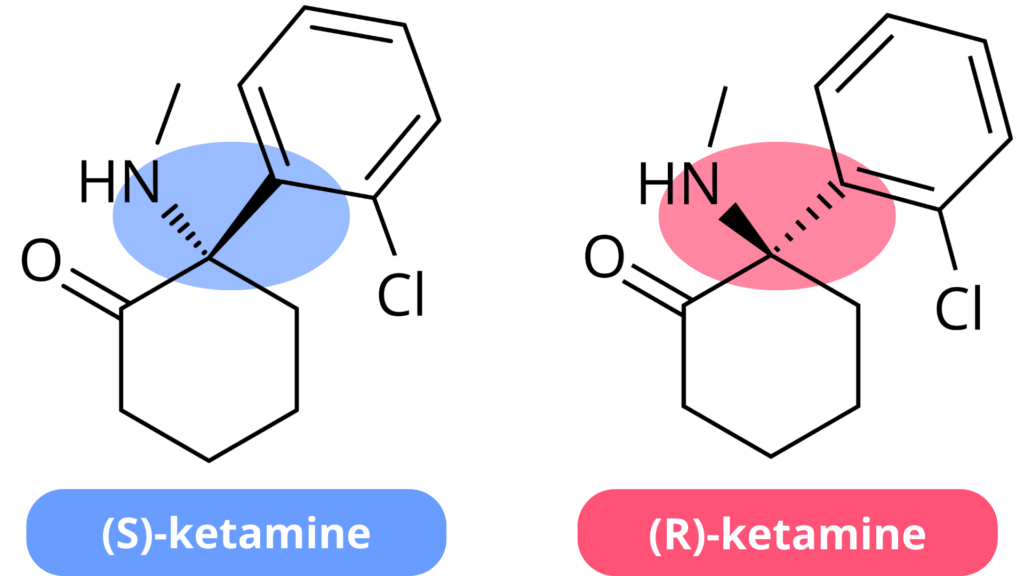
This distinction is important, as some receptors in the body may be more suited to one bend or the other. Imagine that the ketamine molecule is a key that will fit better with a receptor’s keyhole depending on its shape. Some receptors fit better with arketamine, while other receptors fit better with esketamine.
Studies have found esketamine to have a slightly more potent effect than racemic ketamine when administered in the same IV dose, creating more vivid imagery for patients. This is one reason why esketamine, rather than racemic ketamine, was isolated and patented for use as Spravato – a nasal spray that can sometimes be prescribed to treat depression.
Nasal administration, however, is less bioavailable or able to be absorbed by the body than IV administration. With nasal administration, only around 25-50% or up to around 50% of the medication is bioavailable, while 100% of the medication is bioavailable by IV administration.
Another distinction between nasal administration and IV administration is the patient’s experience of receiving the medication. With intranasal treatment, there will be a single spike of medication that fades away quickly. By comparison, IV treatment can deliver a steady dose of the medication over a longer period of time to make for a gentler, more-controlled, and longer-duration dosing. Because it is delivered continuously, IV treatment can also be stopped or slowed down at any point to alleviate experiences of intensity.
Intranasal esketamine, Spravato, is a less effective medication than racemic IV ketamine infusion treatment. The primary limiting factor of Spravato is its nasal delivery. However, it has also been found that esketamine — although it generates more potent imagery — is not more effective in treating mental health than racemic ketamine, even when they are both delivered intravenously.

Arketamine has similarly been investigated for its efficacy compared to racemic ketamine, with the theory that it might be the more potent version for mental health treatment. However, preliminary studies showed that it was not more effective than racemic ketamine either
The racemic mixture of ketamine is more effective than either esketamine or arketamine alone for treating mental health, and IV ketamine infusions are more effective than any other method of delivery including intranasal administration. While both may be effective, compared to instransal esketamine, or Spravato, IV infusions of ketamine yield greater symptom reduction and are as much as twice as effective.
About Us
Wells Medicine is a Houston-based practice designed to provide meaningful care for mental health. Providing targeted interventional treatments for Depression, Anxiety, OCD, PTSD and other conditions, with Ketamine Treatments, Stellate Ganglion Blocks, TMS, and Nitrous-Oxide Treatments. Focused on comprehensive care and integration with Psychiatry, Psychology, and Support Services. We are evidence-based, patient-focused and mission-driven.
The content here is for informational purposes and should not be relied upon for medical decisions. For the details of your specific medical conditions and treatments consult your doctors or other qualified healthcare professionals.