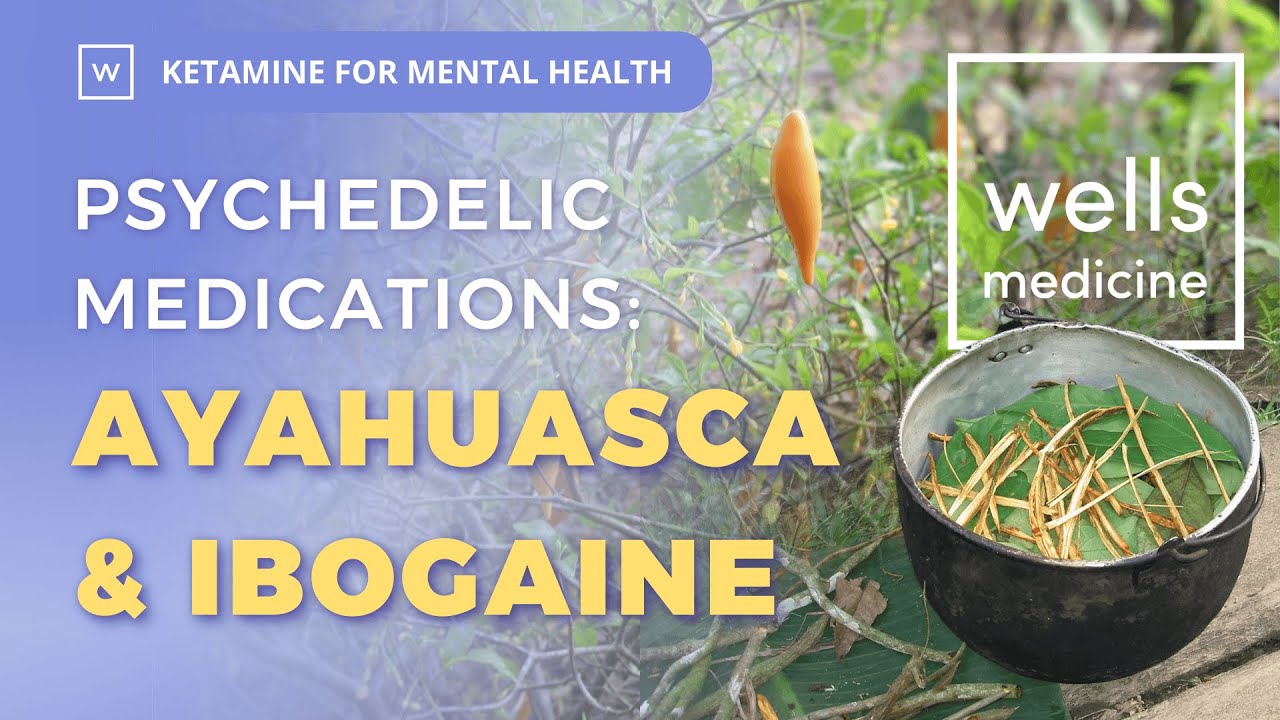
Patients often ask us about psychedelic medications beyond ketamine. Here we review two other psychedelics — ayahuasca and ibogaine.
Other Psychedelic Medications
Similar to ketamine, there are a host of other psychedelic medications that people use to seek treatment for their depression, anxiety, trauma and other mental health symptoms and conditions. Ketamine is a legal psychedelic when used in an appropriate medical setting, with a significant and growing history of research and clinical use. These other medications are not as well-studied as ketamine and do not have the same framework for use. They differ from ketamine and from each other in some interesting and important ways.
For the purpose of this video and post, we will use the term ‘medication’ to mean any substance that has effects in the body.
Ayahuasca
What is ayahuasca?
Ayahuasca is a traditional South American psychedelic mixture. It is not legal in the United States, and some people travel to South America to use it.
Ayahuasca creates a 6-8 hour psychedelic experience, which is generally described as very intense and includes a lot of vomiting and diarrhea. In a clinical setting in the United States, patients would typically be treated for these kinds of side effects – for instance, we treat the side effect of nausea for ketamine infusions. The ayahuasca ‘purge’, however, is considered a part of the experience and is not specifically treated.
With this medication, people often describe experiencing visions of a female deity, or lots of female deities, sometimes called the ‘mother’. There may also be a ‘jungle-y’ theme or feeling to their overall experience. This appears to be the case even when people use ayahuasca illegally in the States, and is certainly described by people who travel to places like Costa Rica, or to countries in Latin America to use the medication.
Often, in Latin America, this medication is provided during a retreat as part of a structured framework with ceremonies and guided by shamans. These retreats frequently take place over the course of multiple days, and participants may experience one, to three, to five journeys over the course of that multi-day program.
Ayahuasca as a Treatment Option
Ayahuasca is not a cure.
A lot of popular press coverage seems to imply that these sessions or retreats are curative. However, ayahuasca is difficult to study and its true efficacy as a treatment is difficult to discern. It is not a regulated medication, the amount of active components in each dosing is highly variable, and the amount of the two ingredients that are blended together to make the mixture of ayahuasca differs from place to place. These factors contribute to the difficulty in comparing results, and in building an evidence-based understanding of its action.
From what data we have seen, any benefit one may receive from ayahuasca certainly does not last forever – it is not a cure. Not everyone benefits from these treatments, and for the people that do appear to benefit the duration of the benefit generally seems to be around 3-6 months before they then seek some for of treatment again for their mental health symptoms.
The experience is intense and comes with risks.
Most people do not want to repeat their ayahuasca experience with any kind of regular frequency. It appears to be too much of an challenging experience — including the travel, vomiting, diarrhea, and the sometimes-disruptive group setting of the sessions.
There is also always the risk of medical emergency. Ayahuasca, depending on how it is mixed, can cause seizures, and patients may experience difficulties from the dehydration caused by their ‘purge’.
There is a risk of medication withdrawal leading up to ayahuasca treatments. Because of the way ayahuasca works chemically in the brain, most retreats ask patients to be off of their antidepressants for up to 6 weeks beforehand. This can be dangerous, as patients tend to quickly taper or stop their medications to be able to go on these retreats. Dangers of rapid withdrawal can include, seizures, increased suicidal ideation, and the resurfacing of severe depression and other symptoms.
At this time, ayahuasca is not something that we can recommend to patients.
It is not legal in the state of Texas, and we see so many side effects compared to the potential duration of benefit. If ayahuasca treatment could be regulated and structured differently with measures of accountability and more stable protocols, it is possible that treatment could provide great benefit in the future. However, we’re just not seeing that at this moment.
Ibogaine
What is ibogaine?
Ibogaine is a natural psychedelic medication originally from central Africa. It has a very potent and long-lasting psychedelic effect – one of the longest-lasting among psychedelics – with journeys or trips lasting 24-36 hours from a single dose.
Ibogaine is described as creating an intense and sometimes distressing experience – notable for its length. It is often described as particularly introspective, and particularly challenging.
Ibogaine does not currently have legal status in the United States. However, there are places where some patients travel to where it does have legal status.
Ibogaine as a Treatment Option
Ibogaine is often used specifically to treat drug and alcohol abuse problems. It does seem to have a high rate of success for this purpose, for helping patients to withdraw and stabilize without going back to their old patterns of use and abuse. However, because of the duration of its effects and how intense the experience is, ibogaine should only be used — if at all — in a therapeutic, monitored, integrated and structured setting.
At this time, we cannot recommend ibogaine treatment to patients.
For one, it is not legal in the state of Texas. Additionally, because it is such an intense and dramatic process, we would only consider recommending it for patients who have failed multiple other medication-assisted drug programs, therapy for drug rehabilitation, and other less intense interventions such as inpatient stays and inpatient therapy.
At this time, ibogaine is not very well studied … and is simply not legal.
About Us
Wells Medicine is a Houston-based practice designed to provide meaningful care for mental health. Providing targeted interventional treatments for Depression, Anxiety, OCD, PTSD and other conditions, with Ketamine Treatments, Stellate Ganglion Blocks, TMS, and Nitrous-Oxide Treatments. Focused on comprehensive care and integration with Psychiatry, Psychology, and Support Services. We are evidence-based, patient-focused and mission-driven.
The content here is for informational purposes and should not be relied upon for medical decisions. For the details of your specific medical conditions and treatments consult your doctors or other qualified healthcare professionals.