The History of TMS

webThumb history of tms

TMS is an advanced treatment option, originally developed in the 1980s, with a growing body of research and use. Therapeutic use has expanded beyond depression for the treatment of additional conditions and symptoms, with a variety of machines, and a growing selection of protocols.
What is TMS?

Transcranial Magnetic Stimulation (TMS) is a non-invasive procedure that uses targeted magnetic pulses to stimulate neurons in the brain. These pulses are sent through a coil placed on the scalp to stimulate areas of the brain (or on other areas of the body to stimulate nerves for pain relief, called Peripheral Nerve Stimulation or PNS). TMS is effective in treating depression, including treatment-resistant depression, and has been shown effective in alleviating symptoms of anxiety, OCD, and other conditions.

TMS is an excellent treatment option because it has good response rates, and can significantly reduce negative symptoms. It has good efficacy for many people, with studies showing lasting results from a single series and especially with the addition of maintenance treatments as needed. TMS is non-invasive, requires no anesthesia, and has minimal side effects. You remain awake during treatment, can drive home, and can return to your normal life following treatment.

Electric shock therapy – the precursor to TMS

Prior to TMS, Electroconvulsive Therapy (ECT), infamously known as Electric Shock Therapy, was more widely used to provide relief from severe symptoms of depression, bipolar disorder, and catatonia. During treatment, patients have two electrodes attached to either side of their scalp and are placed under anesthesia. These electrodes produce an electric current that induces a brief seizure to promote neural plasticity and balance abnormal neurotransmitter levels.

ECT remains in use today. It may produce rapid and effective results in some cases, however it has significant downsides. It requires sedation with general anesthesia (which has its own risks). It may cause side effects including memory loss, headaches, confusion, and muscle tension. The treatment procedures and potential side effects of ECT are responsible for the negative stigma — leading to negative portrayals in media and pop culture. ECT may be an appropriate treatment option in some cases but the bad reputation surrounding ECT is certainly related to the potential real downsides.

The beginning of magnetic stimulation

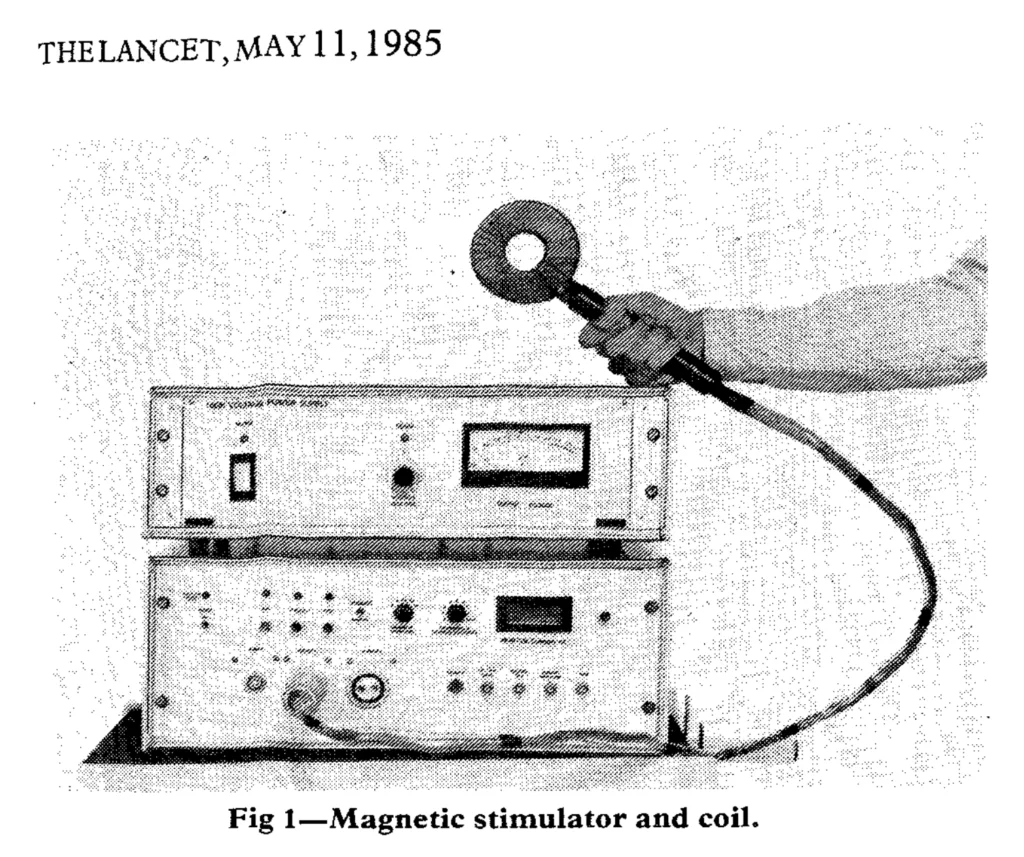
Transcranial Magnetic Stimulation (TMS) represents the evolution from ECT. TMS has been an innovative treatment and new advances are being developed regularly. The critical component to modern TMS was developed in the 1980s and described in a 1985 paper by Dr. Anthony Barker and colleagues: “Non-invasive magnetic stimulation of human motor cortex.”

The work of Barker and colleagues demonstrated that well-tolerated electromagnetic pulses could stimulate the motor cortex and evoke a visible muscle twitch in the hand. This was a landmark – a substantial improvement that really launched the development of the technology.

Figure 1 - Magnetic stimulator and coil
The original TMS device from the 1985 paper looks fundamentally similar to the TMS machines we use in the clinical setting today.

Gaining traction among researchers

The newly introduced TMS device stood out from previous methods of electrical and magnetic stimulation. Its gentle, non-invasive nature and ability to deliver repeated pulses allowed researchers to stimulate a wider range of brain regions, including deeper areas. Furthermore, the ability to deliver multiple pulses in short time periods allowed for the ability to elicit both excitatory and inhibitory responses. As a result, TMS quickly gained popularity among researchers and multiple studies were conducted to aid our understanding of brain structures, their role in cognitive processes, and the use of this technology for therapeutic applications.

Early studies validated TMS and the ability to activate brain areas through non-invasive magnetic pulses. Although not originally used to study depression, TMS research established safety protocols to ensure side effects would be minimal and resolved quickly. Also, these studies supported the use of TMS as a long term treatment option with lasting benefits.

Here are some of the early studies that expanded our knowledge on the Corpus Callosum (i.e., left and right brain connection), the visual cortex, and different areas involved in language production and comprehension.

The development of TMS

For many years, TMS was used strictly as a research tool until, in the 2000s, it was recognized as a therapeutic treatment option. The ability to deliver multiple magnetic pulses in a short period of time and elicit both inhibitory and excitatory responses provided benefits for different types of mental health disorders. In 2008, The FDA approved the first TMS device to treat Major Depressive Disorder (MDD) in adults with inadequate response to antidepressants. Soon after, multiple devices became FDA approved, including MagVenture, which has become the dominant standard for research and a leading device for evidence-based practices (and which we use at Wells Medicine).

TMS was first used to treat depression, however, and subsequent studies support the use of TMS for other conditions and symptoms. There continues to be development of treatments for different indications and using different devices and different protocols as the field develops.

FDA approvals – the development of TMS

The U.S. Food and Drug Administration (FDA) regulates the safety and efficacy of drugs and medical devices such as TMS. An FDA approval often indicates that a treatment has moved beyond the experimental phase and can be used clinically.

These dates below highlight the continuous breakthroughs for unique TMS device types along with their navigation precision and protocols:

2008

TMS approved to treat depression in adults – NeuroStar

2008
2013

TMS approved to treat migraines – ENeura

This is timeline description. Please click here to change this description.

2013
2015

Tonica Elektronik (Magventure)

This is timeline description. Please click here to change this description.

2015
2017

TMS approved to treat OCD – BrainsWay Deep

This is timeline description. Please click here to change this description.

2017
2018

Intermittent Theta Burst Stimulation (iTBS) protocol

This is timeline description. Please click here to change this description.

2018
2020

TMS approved for smoking cessation – BrainsWay

This is timeline description. Please click here to change this description.

2020
2021

TMS approved for anxious depression (MDD with comorbid anxiety)

This is timeline description. Please click here to change this description.

2021
2022

Accelerated TMS and SAINTS protocol

This is timeline description. Please click here to change this description.

2022
2023

Neuro Navigation System approved – designed for personalized and accurate positioning of the treatment coil
TMS approved for Pain Therapy

This is timeline description. Please click here to change this description.

2023
2025

TMS approved to treat Depression in adolescents, ages 15-21

This is timeline description. Please click here to change this description.

2025

Beyond FDA approvals

FDA approvals provide a useful picture of the history and development of TMS, but they don’t tell the whole story.

FDA approvals are important to follow closely; however, many FDA-approved treatments are subsequently used “off-label” in different ways. Off-label use is a standard part of medicine, with around 20% of all medications are used off-label, for instance.

Off-label use can include treatments nearly identical to the FDA approved treatments to treatments that are distinctly different from the original use or indication approved by the FDA. In all cases, responsible providers rely on demonstrated evidence from the best-available research and clinical information to guide their care, whether FDA approved or not. Often FDA approval is simply not pursued because no one company stands to benefit by pouring money into the FDA approval process.

From rTMS to aTMS

Repetitive TMS (rTMS)

Standard method consisting of 20-minute sessions for 6+ weeks

Intermittent Theta Burst
Stimulation (iTBS)

An accelerated version of rTMS (3-10 min)

Deep TMS (dTMS)

Utilizes different coil specialized for reaching deeper brain areas, and typically washes the entire brain with electromagnetic waves instead of targeted areas

Accelerated TMS (aTMS)

Consists of multiple sessions per day for 5-10 days

Repetitive TMS (rTMS)

Standard method consisting of 20-minute sessions for 6+ weeks

Intermittent Theta Burst Stimulation (iTBS)

An accelerated version of rTMS (3-10 min)

Deep TMS (dTMS)

Utilizes different coil specialized for reaching deeper brain areas, and typically washes the entire brain with electromagnetic waves instead of targeted areas

Accelerated TMS (aTMS)

Consists of multiple sessions per day for 5-10 days

The future of TMS

The research inquiry into, and clinical application of, TMS is expanding rapidly. There are some exciting developments, with therapeutic applications coming available frequently.

Accelerated TMS is a new approach that reduces a treatment series from daily sessions over 5 to 7 weeks (or more) to a single week –- delivering more total sessions, generally at a greater intensity, and demonstrating better efficacy in limited studies than conventional rTMS. A version of accelerated TMS called SAINT or SNT received FDA approval in 2022.

One-day TMS is an even newer approach that takes some of the best of what we know about effective TMS and condenses a treatment series into a single day. The current state of this protocol is widely based on a study published in December, 2024.

New directions in TMS include multiple new machines and delivery configurations, including, for instance, a suitcase-sized device that uses a camera for accurate placement to a headset that you keep at home and wear regularly for low-dose treatment sessions.

There are many research offshoots. As an example, we are working with a start-up that is developing a miniature implantable coil that could provide responsive stimulus as needed toward even better efficacy for particularly severe symptoms.

As the field of inquiry and experimentation expands, we are finding new ways to deliver TMS and new applications. Some of the most exciting new work is designed to help people with Alzheimer’s, stroke recovery, Parkinson’s Disease, smoking cessation, ASD, and ADHD.

About Us

Wells Medicine is a Houston-based practice designed to provide meaningful care for mental health. Providing targeted interventional treatments for Depression, Anxiety, OCD, PTSD and other conditions, with Ketamine Treatments, Stellate Ganglion Blocks, TMS, and Nitrous-Oxide Treatments. Focused on comprehensive care and integration with Psychiatry, Psychology, and Support Services. We are evidence-based, patient-focused and mission-driven.

The content here is for informational purposes and should not be relied upon for medical decisions. For the details of your specific medical conditions and treatments consult your doctors or other qualified healthcare professionals.

References and Resources

Hamlin D, Garman J. A Brief History of Transcranial Magnetic Stimulation. American Journal of Psychiatry Residents’ Journal. 2023;18(3):8-10. doi:https://doi.org/10.1176/appi.ajp-rj.2023.180303

Rothwell J. How TMS came of age. Transcranial Magnetic Stimulation. Published online September 2024:100002. doi:https://doi.org/10.1016/j.transm.2024.100002

Cohen SL, Bikson M, Badran BW, George MS. A visual and narrative timeline of US FDA milestones for Transcranial Magnetic Stimulation (TMS) devices. Brain Stimulation. 2022;15(1):73-75. doi:https://doi.org/10.1016/j.brs.2021.11.010

Terao Y, Ugawa Y. Basic Mechanisms of TMS. Journal of Clinical Neurophysiology. 2002;19(4):322-343. https://journals.lww.com/clinicalneurophys/Abstract/2002/08000/Basic_Mechanisms_of_TMS.6.aspx