Originally used to treat depression, Transcranial Magnetic Stimulation (TMS) has proven to be a transformative treatment option for many people with Obsessive Compulsive Disorder (OCD). Wells Medicine offers accelerated TMS protocols designed to target severe and treatment-resistant OCD symptoms, providing a path toward rapid and lasting relief.
What is OCD?
Obsessive Compulsive Disorder (OCD) is a chronic mental condition characterized by a cycle of obsessions (intrusive, distressing thoughts) and compulsions (repetitive behaviors performed to neutralize the distress).
Obsessions: Intrusive, unwanted thoughts, mental images, or impulses causing distress
- Concerns about one’s or another’s safety
- Need for order or symmetry
- Doubt for a relationship
Compulsions: Also known as Rituals, are repetitive behaviors or mental acts in response to obsessions to temporarily avoid negative emotions and anxiety
- Repeated cleaning, excessive hand washing and showering
- Repeated organization
- Repeated checking of locks, doors, switches
- Seeking continuous approval
- Repeated counting or behavior to a set number of times or “until it feels even or right”
What is TMS?
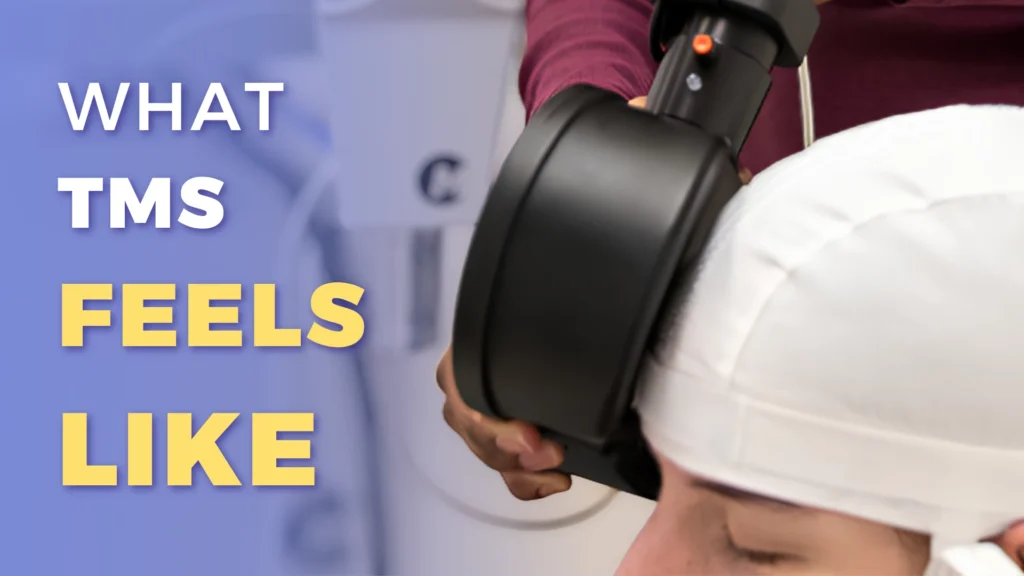
TMS is a non-invasive procedure that uses targeted magnetic pulses to stimulate neurons in specific brain regions.
TMS has been shown to be effective in alleviating symptoms of depression, anxiety, OCD, other mood disorders, some pain conditions, and some other conditions and symptoms. TMS is often considered an excellent treatment option because it is non-invasive and has minimal side effects. Patients remain awake during treatment and can drive home and return to their regular activities immediately afterward. TMS is also shown to provide substantial and lasting relief for many people, even for people with treatment-resistant symptoms.
How TMS may help with OCD
OCD is often linked to dysregulation in the Cortico-Striato-Thalamo-Cortical (CSTC) Loop. The CSTC loop is considered the communication highway between different brain regions. These brain areas and the communication between them can become dysregulated for many different reasons. The most common are genetics, environmental factors, neurotransmitter levels, structural differences, and overactive brain areas. In many cases, specific regions within this circuit become hyperactive, leading to the “stuck” thoughts characteristic of the disorder.
TMS uses targeted magnetic pulses to modulate these deep-seated circuits. By inducing neuroplasticity, TMS helps “reset” the balance of the CSTC loop. This allows patients to think outside of recursive patterns and often makes concurrent therapies, such as Exposure and Response Prevention (ERP), significantly more effective.
OCD Brain Dysfunction May Include:
- The inability to suppress or stop thoughts
- Increased attention on thoughts leading to obsessions
- Thoughts that become rigid, stuck, trapped, or recursive
- The inability to change or monitor your responses and behaviors
TMS May Help By:
- Promoting / inducing neuroplasticity
- Yielding more robust, healthy neural activity
- Allowing patients to reduce, escape, or think outside recursive thought patterns
- Facilitating / enabling productive exposure therapy or other therapeutic work
TMS may provide a greater than 35% reduction in OCD symptoms, with a 60% response rate. Actual results may vary from person to person, and results reporting is complicated by limited studies and the variety of equipment and protocols used in treatment. It is clear that TMS can provide a substantial reduction of OCD symptoms for many people – and TMS often provides strong, lasting benefits.
Symptom provocation
A unique part of TMS treatment for OCD, compared to TMS treatments for other conditions, includes the symptom provocation. Patients are asked to deliberately provoke their obsessive and/or compulsive symptoms with the goal of activating the neural networks involved in OCD during treatment sessions.
The provocation experience varies for each patient as it is specific to their symptoms. This is an independent process and may be led or assisted by a provider if necessary. For example, a patient with the fear of germs may be asked to either visualize locations feared for their germs or be asked to touch a surface without washing their hands immediately afterwards. Patients self-report their distress for the technician before starting treatment, with the goal of having moderate to high levels of symptom activation. This process may be difficult for some patients; however, symptom provocation is a tested and approved procedure for TMS. The short-term discomfort strengthens the long-term impact of treatment.
The OCD Protocol
TMS has FDA approval for OCD treatment for both focused or targeted TMS, and for broad TMS that washes much of the brain with electromagnetic waves – called deep TMS or dTMS. Both approaches may be used to deliver repeated magnetic pulses and reach areas of the brain impacted by OCD.
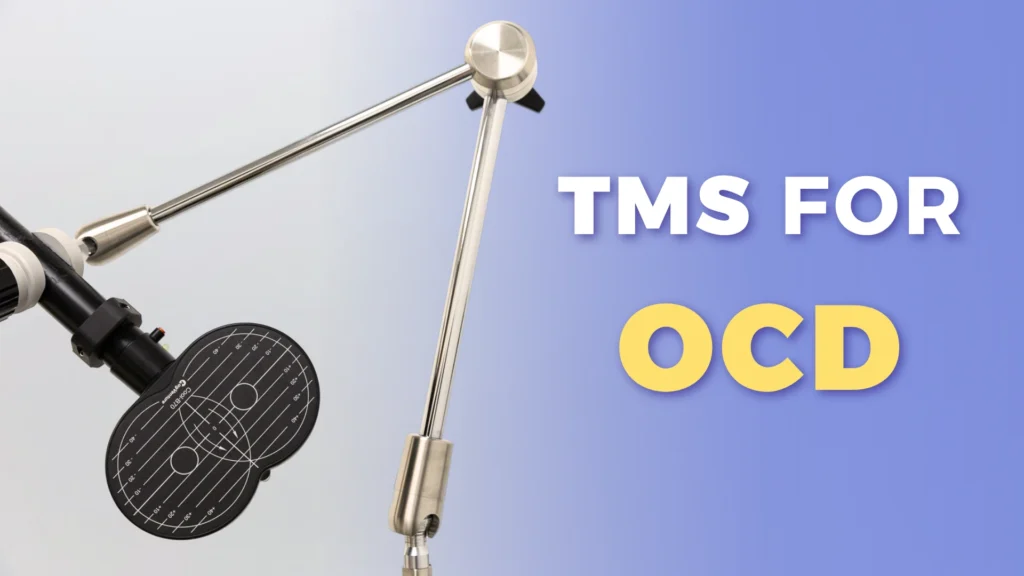
The MagVenture device is the leading machine for research and clinical targeted TMS treatments using focused targeting. It has two coils that are well-suited for the treatment. The cool-D80 coil was approved for OCD as it targets deep brain regions (Anterior Cingulate Cortex). The cool-B70 coil is an FDA-approved coil for various indications, originally for depression and now also for OCD. These coils have broad inter-operability, and are functionally equivalent when considering the field patterns and especially when considering clinical use, including that individualized treatment strengths are calibrated to analogous depth motor areas of the brain for each patient.
Beyond FDA approvals
FDA approvals are important to follow closely, however, many FDA-approved medications and treatments are subsequently used “off-label” in different ways due to expanding research. Around 20% of all medications are used off-label, and off-label use is an important part of every-day medicine.
Off-label uses can be very close, or even nearly identical, to FDA-approved treatments or they can vary significantly. In all cases, responsible providers rely on demonstrated evidence from the best-available research and clinical information to guide the use of treatments, whether FDA-approved or not. In our office, we use the FDA-approved MagVenture machine and accelerated protocols.
Accelerated TMS
Wells Medicine provides accelerated TMS treatments which uses the best-available information toward rapid and effective treatment –- providing more rapid care and with limited studies showing similar to far greater results than conventional TMS protocols, much more quickly. Our OCD protocol uses a lower motor threshold motor intensity (90%) compared to other protocols (110-120%), which is beneficial for patients tolerance, safety, and fatigue while remaining effective.
TMS can be an excellent option for OCD
Living with OCD can impact one’s life in so many ways. It can be especially difficult if ongoing treatments, therapies, and medications haven’t yielded significant improvements.
TMS is fast, non-invasive, convenient, has minimal side effects, and can be incredibly effective. TMS can be an excellent option for treating OCD.
About Us
Wells Medicine is a Houston-based practice designed to provide meaningful care for mental health. Providing targeted interventional treatments for Depression, Anxiety, OCD, PTSD and other conditions, with Ketamine Treatments, Stellate Ganglion Blocks, TMS, and Nitrous-Oxide Treatments. Focused on comprehensive care and integration with Psychiatry, Psychology, and Support Services. We are evidence-based, patient-focused and mission-driven.
The content here is for informational purposes and should not be relied upon for medical decisions. For the details of your specific medical conditions and treatments consult your doctors or other qualified healthcare professionals.
Select References
Lusicic A, Schruers KRJ, Pallanti S, Castle DJ. Transcranial magnetic stimulation in the treatment of obsessive–compulsive disorder: current perspectives. Neuropsychiatric Disease and Treatment. 2018;14:1721–1736. doi:10.2147/NDT.S121140.
Mudunuru AK, Reddy MS, Valipay K, Balaji SA, Madhiha M, Chandresh N, Chandrasekhar K, Gundugurti PR. The clinical efficacy of accelerated deep repetitive transcranial magnetic stimulation in depression and obsessive-compulsive disorder: multi-centric real-world observational data. Cureus. 2024;16(5):e60895. doi:10.7759/cureus.60895.
Maia A, Almeida S, Cotovio G, Rodrigues da Silva D, Viana FF, Grácio J, Oliveira-Maia AJ. Symptom provocation for treatment of obsessive-compulsive disorder using transcranial magnetic stimulation: a step-by-step guide for professional training. Frontiers in Psychiatry. 2022;13:924370. doi:10.3389/fpsyt.2022.924370. PMCID: PMC9382110.
International OCD Foundation. Transcranial magnetic stimulation (TMS) for OCD. iocdf.org. Accessed April 21, 2026.
MagVenture. FDA expands MagVenture TMS indications to treat MDD, OCD, and anxious depression with one coil. Published September 2, 2025. Accessed April 21, 2026.
U.S. Food and Drug Administration. 510(k) Premarket Notification K251119: MagVenture TMS Therapy System. Tonica Elektronik A/S. Dated July 11, 2025; Received July 14, 2025. Accessed April 21, 2026. https://www.accessdata.fda.gov/cdrh_docs/pdf25/K251119.pdf