TMS for multiple conditions

webThumb tms multiple conditions

About half of all people living with a mental health condition also meet the criteria for at least one other condition. This overlap, called comorbidity, can make finding the right treatment option more difficult. Transcranial Magnetic Stimulation (TMS) can be an effective treatment option for comorbid conditions, and there are several ways to use TMS to treat more than one condition in these cases.

What is comorbidity?

Comorbidity is when two or more mental health conditions occur simultaneously. Sometimes they are closely related and sometimes they are entirely separate. 

There is a high risk of developing comorbitities when living with mental conditions over time, especially when symptoms go untreated or are more severe. 

Comorbidity is quite common, and there are many potential combinations. One of the most frequent pairings is depression and anxiety.

There are several reasons that comorbidity is common:

  • A Biological Connection: Some conditions share biological risks. For example, anxiety & depression share significant genetic risk factors, with correlation as high as 80% or more
  • Overlapping Symptoms: Some conditions have shared symptoms. PTSD and panic disorders, for instance, involve intrusive thoughts, hyperawareness, and heightened physical sensations
  • The Cascade Effect: Untreated conditions and severe symptoms may trigger a second condition to emerge. Extreme mental fatigue from OCD may contribute to or lead to depression, for instance. Panic attacks in public spaces may contribute to or lead to agoraphobia

TMS as a treatment for multiple conditions

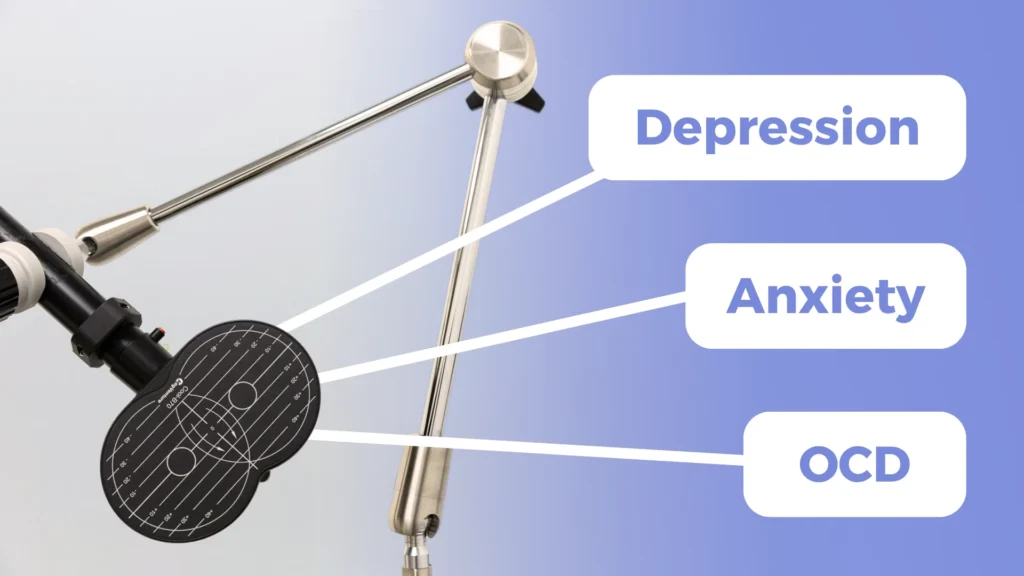
TMS is a flexible and advanced treatment option that can provide relief from a variety of symptoms and conditions, including depression, anxiety, OCD, and more, with a growing body of research and clinical evidence supporting its use across an expanding range of symptoms and protocols. 

When treating comorbid conditions with TMS, you have several main approaches:

  • Single Site TMS: A single protocol may address more than one condition, either because the protocol helps multiple conditions directly, or because helping one condition then leads to improvements in other conditions
  • Dual Site TMS: Two protocols may be used together at the same time – targeting more than one site over the course of a day or week of treatments, for instance
  • Series TMS: Two protocols may be used in series, with one after the other, separated by any length of time

Single Site TMS: One Protocol That May Benefit More Than One Condition

Single Site TMS targets one diagnosis and set of symptoms with a single protocol. The single treatment may, nonetheless, improve more than one condition.

Even when facing comorbid mental health conditions, single site TMS can an excellent choice and is often the best place to start. It allows the patient and care team to focus on the most pressing condition first. It is often effective for severe and treatment-resistant symptoms. It may help the other comorbid conditions, in any case.

While single site accelerated TMS can be a full day or set of days, there may be time between sessions to focus on goals and strategies for your mental health care. This inter-session time can be an excellent time to practice therapy exercises, or other ‘homework’, or journaling, or meditation, or activities.

Single Site TMS:

  • Ensures a full treatment optimized for and focused on the primary condition
  • Regular pacing of treatment sessions may be the most manageable for the patient
  • The single protocol / target location may help with other conditions or symptoms 
  • Often the best place to start, with the option to add more treatments at a later time

Dual Site TMS: Two Protocols At The Same Time

Dual site TMS is when two locations or protocols are used to address two conditions simultaneously during a single visit. Separate conditions are addressed by stimulating one target area of the brain and then immediately switching to a different target location. 

One example of dual site TMS is using high-frequency stimulation for depression on the left side of the brain and low-frequency stimulation for anxiety on the right side of the brain. There are many potential variations using multiple sites within a single protocol, or running separate protocols with separate sites at the same time.

Dual Site TMS:

  • Ensures a full treatment optimized for each separate condition, with the two conducted at the same time
  • May be more efficient – with less total trips to the office and requiring less total resources to complete
  • Requires busy days, with more time setting the machines and place the coil in separate locations (often different sides of the brain). In addition, protocols for OCD require more time for provocation 
  • Having more treatment sessions in a condensed time period may feel more intense

Series TMS: Two (or More) Protocols At Different Times 

In this approach separate conditions are addressed by completing a full course of treatment for one condition before starting a full course for another. The focus remains on the treatment at hand each time. By completing separate protocols at different times, you may be able to measure what symptoms are getting better after the first protocol before introducing the second one.

Series TMS:

  • Ensures a full treatment focused on each separate condition
  • Reduced chance of side effects: TMS side effects, such as headaches, while typically mild and transient, may be less intense if multiple treatments are administered separately
  • Symptom Relief: By treating the most debilitating condition first, the second comorbid condition may be easier to manage on its own 
  • You can see how it goes: Using treatments in series is often an excellent approach when you and your care team would like to see how well the first treatment works before beginning additional treatments
  • Time for Provocation: When treating OCD, specifically, the treatment protocol requires provocation (triggering obsessive thoughts), doing it on its own allows for more time and focus on these treatment requirements
Which Approach Is Right For You?

The best approach may depend on your specific conditions, their severity, recommendations by your providers, your preferences, and factors such as schedule flexibility, resources, and access to care. Many people start with a single-site TMS and add additional treatments later if and as needed. Others wish to pursue more aggressive and rapid improvements with combined treatments or protocols.

TMS can be flexible, and works well with other treatments, including other TMS protocols, ketamine infusions, stellate ganglion blocks, medication management, and psychotherapy. Often the way in which these treatments might be combined matters less than continuing to pursue treatments or modalities until you find ones that work well for you, and then continuing those treatments that are most helpful to you as appropriate.
Whether targeting one or multiple conditions, TMS can be highly effective. TMS can be a great non-invasive treatment option, with minimal side effects, minimal office visits, and the potential for significant and lasting symptoms reduction for many people, even for many people with long-standing and treatment resistant symptoms.

About Us

Wells Medicine is a Houston-based practice designed to provide meaningful care for mental health. Providing targeted interventional treatments for Depression, Anxiety, OCD, PTSD and other conditions, with Ketamine Treatments, Stellate Ganglion Blocks, TMS, and Nitrous-Oxide Treatments. Focused on comprehensive care and integration with Psychiatry, Psychology, and Support Services. We are evidence-based, patient-focused and mission-driven.

The content here is for informational purposes and should not be relied upon for medical decisions. For the details of your specific medical conditions and treatments consult your doctors or other qualified healthcare professionals.

Select References

Jimenez C, Cha J, Imtiaz Z, Olson S, O’Neill S, Choi KS, Figee M, Smith AH. Safety and tolerability of dual-site accelerated transcranial magnetic stimulation treatment for obsessive-compulsive disorder and major depressive disorder. Transcranial Magnetic Stimulation. 2025;4:100182. doi:10.1016/j.transm.2025.100182.

Stubbeman WF, Yang J, Converse J, Gencosmanoglu M, Morales Ortega D, Morris J, Sobocinski A, Li V, Gunawardane G, Edelen Y, Khairkhah R, Perez J. Neuronavigated right orbitofrontal 20 Hz theta burst transcranial magnetic stimulation augmentation for obsessive–compulsive disorder with comorbid depression and anxiety disorders: an open-label study. Brain Sciences. 2024;14(5):483. doi:10.3390/brainsci14050483.

Tadayonnejad R, Wilson AC, Corlier J, Lee JC, Ginder ND, Levitt JG, Wilke SA, Marder KG, Krantz D, Bari AA, Feusner JD, Pouratian N, Leuchter AF. Sequential multi-locus transcranial magnetic stimulation for treatment of obsessive-compulsive disorder with comorbid major depression: a case series. Brain Stimulation. 2020;13(6):1600–1602. doi:10.1016/j.brs.2020.10.003. PMID: 33065361.

Wei J, Chen S, Zhou C. Targeting brain networks: a review of multi-site TMS techniques and applications. Brain-Apparatus Communication: A Journal of Bacomics. 2025;4(1). doi:10.1080/27706710.2025.2583774.

Sharma E, Sharma LP, Balachander S, Lin B, Manohar H, Khanna P, Lu C, Garg K, Thomas TL, Au ACL, Selles RR, Højgaard DRMA, Skarphedinsson G, Stewart SE. Comorbidities in obsessive-compulsive disorder across the lifespan: a systematic review and meta-analysis. Frontiers in Psychiatry. 2021;12:703701. doi:10.3389/fpsyt.2021.703701. PMID: 34858219; PMCID: PMC8631971.

Kessler RC, Chiu WT, Demler O, Walters EE. Prevalence, severity, and comorbidity of 12-month DSM-IV disorders in the National Comorbidity Survey Replication. Archives of General Psychiatry. 2005;62(6):617–627. doi:10.1001/archpsyc.62.6.617.

National Institute of Mental Health. Mental illness. Updated September 2024. Accessed June 11, 2026. https://www.nimh.nih.gov/health/statistics/mental-illness