
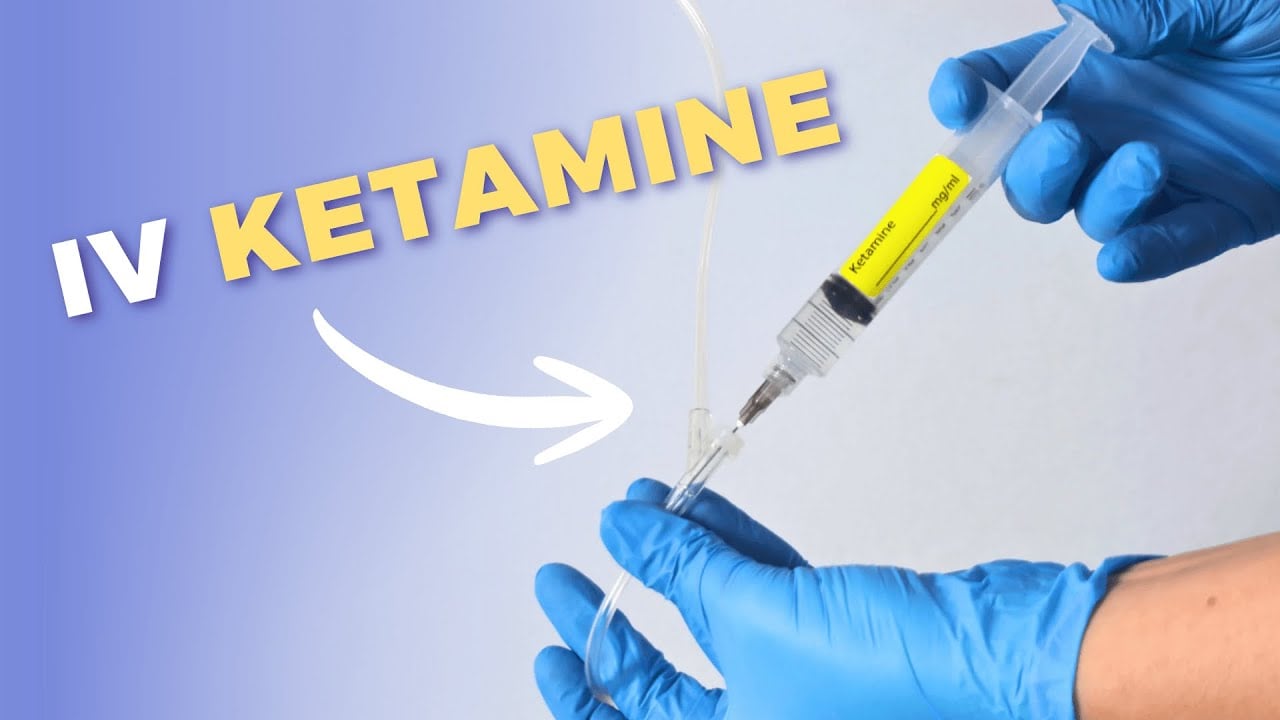
There are many ways to administer ketamine to the body, but the best way to do it is through an IV.
How ketamine gets into the body
Ketamine is an interesting medication in that it can be administered to the body in many different ways. It can be taken orally, sprayed up the nose, rubbed on the skin, infused through an IV catheter, or given as an intramuscular injection. There is research being done on subcutaneous injections, and some patients have even received ketamine as rectal suppositories or intravaginal suppositories.
Each of these administration methods has its own benefits and side effects. At Wells Medicine, we use IV ketamine and intramuscular (IM) injections of ketamine.
A majority of the research on ketamine treatment has been done on and IV infusion, typically over the course of 40 minutes. IV administration provides the benefit of the medication being 100% bioavailable — or 100% able to be absorbed by the body through the bloodstream. This makes the absorption of ketamine extremely predictable, which is not the case for other administration methods.
With intranasal administration, only 25-50% of the medication is bioavailable. With oral administration, bioavilablity can be as little as 16-20% by mouth or 24-30% sublinguially. This is a wide range for how much of a dose patients will receive, and often, our patients feel a great difference in their treatment experience between as small as a 5mg difference in the amount of ketamine they receive.
Not only is the amount of ketamine that is absorbed by the body much more unpredictable with intranasal and oral administration, the rate at which ketamine is absorbed by the body is unpredictable. The curves of treatment are very unpredictable, as there is no real way of knowing when exactly the peak of absortion is going to hit. Patients may have very vivid, intense experiences at the beginning that are more than they would prefer, and then taper off very quickly. The patient may be surprised by a second absorption peak later on when the ketamine hits their stomach or their small intestine.
Intramuscular ketamine injections have a far higher bioavailability at 93%. This makes the dosing much more consistent, although the absorption peaks may still be difficult to predict. Different people have different blood flows to their muscles, which means some may absorb it a little faster than others. An injection that hits fatty tissue in the muscle can also result in slower absorption.
The perks of an IV
IV administration means predictable absorption of the medication into the body, both in terms of dosing and the rate at which ketamine is absorbed by the body. IV administration precisely controls the rate at which ketamine drips into the blood stream, and also makes it so that patients can slow or stop their infusion midway through if things begin to get too intense.
One other benefit of an IV is that it allows for other medications to be administered and absorbed by the body very quickly. This makes it much easier to administer medications including anti-nausea medications and anti-hyperintensive or blood pressure medications. Although we can also administer oral versions of these medications, they take much longer to start working — 15-20 minutes as opposed to 1-5 minutes using an IV.
Using an IV, we are able to get patients comfortable much more quickly.
needles and catheters
For both IV and IM treatment, we use very small needles.
In order to reduce the peak of absorption and make it a more comfortable treatment for patients, IM ketamine treatment is broken up into 2 injections. For a patient with a ketamine dose of 60mg, they would most likely receive an injection of 40mg of ketamine and a second injection of 20mg about 15 minutes later. These injections are given using a needle gauge that is close in size to what is used for flu shots and vaccines.
Although IM treatment involves two injections and has the limitation of only being able to administer anti-nausea and anti-hyperintensive medications orally, some patients prefer this treatment as the idea of having something under their skin during an infusion is bothersome to them.
Some patients are afraid that they may accidentally hurt themselves with the needle by bending their arm during an IV infusion. However, it is important to clarify that there is no needle still in place during treatment. When an IV is placed, the needle is removed and leaves behind a catheter. This catheter is a very small, thin tube that becomes very flexible and soft at body temperature. You can bend and move your arm comfortably and the catheter will bend and flex with the movement.
At Wells Medicine, we use the smallest size IV catheter available, a 24 gauge catheter used for infants in neonatal hospitals. We are able to use such a small size because we administer such a small amount of medication over a long period of time, and this size is often smaller than what patients may have encountered when given an IV under other circumstances.
The goal of an IV is to create a two-way tube in the vein. With a really good IV, not only are medications able to be administered into the blood stream but you can also get blood flow back. Some patients will notice that there’s a little big of blood in their catheter. This is normal, and just a sign of a well-placed IV.
When the procedure is done, the catheter is removed and we cover the injection site with a band-aid. The skin and vein heal over the course of about 3-5 days. For patients who aren’t on blood thinners, we can typically avoid creating a bruise from the IV by simply holding pressure on the injection site for about a minute.
About Us
Wells Medicine is a Houston-based practice designed to provide meaningful care for mental health. Providing targeted interventional treatments for Depression, Anxiety, OCD, PTSD and other conditions, with Ketamine Treatments, Stellate Ganglion Blocks, TMS, and Nitrous-Oxide Treatments. Focused on comprehensive care and integration with Psychiatry, Psychology, and Support Services. We are evidence-based, patient-focused and mission-driven.
The content here is for informational purposes and should not be relied upon for medical decisions. For the details of your specific medical conditions and treatments consult your doctors or other qualified healthcare professionals.


